
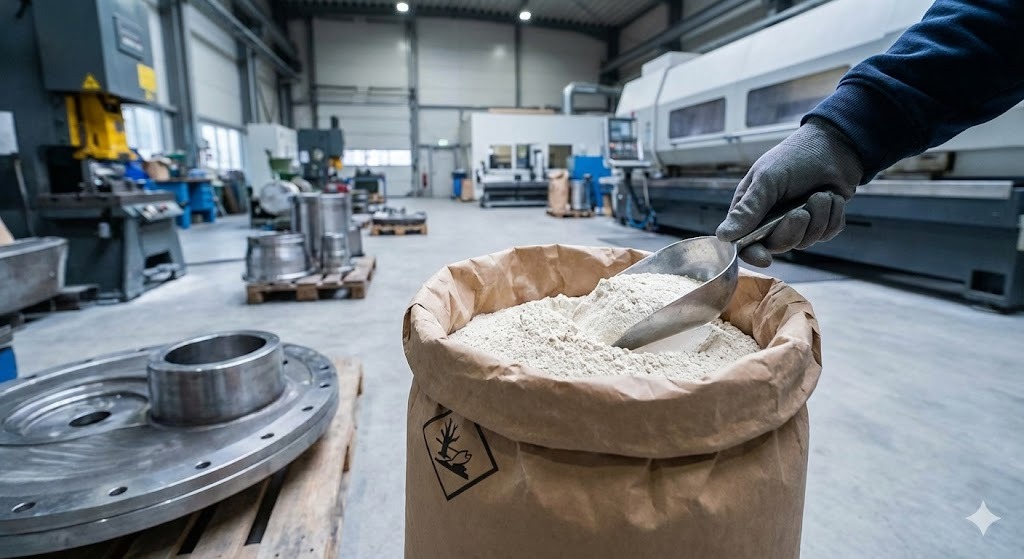
Hello! In the fast-paced world of industrial manufacturing, the difference between a good product and a great one often lies in the additives. While resins, polymers, and binders get the spotlight, industrial talc powder is the silent workhorse that enhances performance, durability, and cost-efficiency.
Whether you are formulating a weather-resistant industrial coating, compounding a high-performance rubber seal, or molding a rigid fiberglass boat hull, talc is likely a critical part of your formula. However, not all talc is created equal.
At Winstone Technology, we understand that industrial buyers need more than just a “white powder.” You need a functional mineral engineered for specific physical properties. As a dedicated manufacturer in Thailand, we are here to explore how high-quality industrial talc can transform your production line, specifically in the Paint, Rubber, and Fiberglass sectors.
What is Industrial Talc Powder?
Industrial talc powder is processed from the mineral talc (hydrated magnesium silicate). Unlike the perfumed powder found in bathroom cabinets, industrial grade talc is strictly defined by its functional properties:
- Lamellar (Platy) Structure: Its microscopic plates slide over each other to provide lubrication or stack to create barriers.
- Chemical Inertness: It does not react with acids, bases, or industrial chemicals.
- High Thermal Stability: It withstands the heat of processing (like extrusion) without degrading.
- Whiteness and Purity: It serves as a bright extender without altering the color of the final product.
Winstone Technology: Your Manufacturing Partner
Why should you source your industrial talc powder from Winstone Technology?
- We Are Manufacturers: We are not traders. We operate our own factory in Samuthsakorn, Thailand. This means we control the milling, classification, and quality testing.
- R&D Capabilities: We can customize particle sizes (D50/D97) to meet your specific industrial requirements.
- Experience: We build upon the legacy of our parent company, China Trading Co., Ltd., which has been serving the industry since 1987.
- Safety First: We guarantee 100% Asbestos-Free products, ensuring the safety of your workforce and compliance with global safety regulations.
Key Application: Industrial Paints and Coatings
In the paint industry, industrial talc powder is a vital functional extender. It is used in everything from architectural paints to heavy-duty marine coatings.
- Corrosion Protection: The platy particles of talc orient themselves parallel to the substrate, creating a “labyrinth” barrier. This makes it difficult for moisture and corrosive agents to reach the metal surface.
- Matting Agent: Talc naturally scatters light. We produce grades that effectively control gloss, allowing you to achieve satin or matte finishes without expensive matting additives.
- Reinforcement: It reinforces the paint film, preventing cracking and peeling over time.
- Rheology: It improves the flow and leveling of the paint, preventing sagging on vertical surfaces.
Key Application: Rubber Compounding
For the rubber industry, talc is a multifunctional additive used in EPDM, SBR, and Natural Rubber compounds.
- Processing Aid: Talc acts as an internal lubricant. It reduces the viscosity of the rubber mix, allowing for faster extrusion and lower energy consumption during processing.
- Reinforcement: It improves the modulus (stiffness) and dimensional stability of rubber parts, such as automotive seals, gaskets, and hoses.
- Anti-Block/Anti-Tack: It is widely used to dust uncured rubber sheets to prevent them from sticking together during storage and transport.
Key Application: Fiberglass (FRP) and Composites
The Fiberglass Reinforced Plastic (FRP) industry utilizes industrial talc powder to improve the mechanical properties of polyester and epoxy resins.
- Stiffness Enhancement: Talc significantly increases the flexural modulus (stiffness) of the composite, allowing for the production of rigid parts like boat hulls and automotive panels.
- Shrinkage Control: Resin shrinks as it cures (exothermic reaction). Talc helps mitigate this shrinkage, ensuring that the final part matches the mold dimensions perfectly.
- Surface Quality: Using fine-mesh talc improves the surface finish of molded parts, reducing the labor required for sanding and finishing.
Other Industrial Uses
Beyond the “Big Three” (Paint, Rubber, Fiberglass), our industrial talc powder is also essential for:
- Plastics: Increasing stiffness and heat deflection temperature (HDT) in PP and PE.
- Ceramics: Preventing thermal expansion cracks in tiles and sanitaryware.
- Paper: Improving opacity and printability.
- Adhesives: Acting as a cost-effective filler that improves viscosity control.
Product Specifications
We offer a range of industrial grades tailored to different performance needs.
| Product Code | Whiteness (Hunter Lab L*) | Particle Size D50, D97 (Micron) | Recommended Industry |
| WIN7D27R (P0151007025H) | 92 min. | 6±2, 20±3 | General Paint, Rubber, Plastics |
| WIN7D27R (P016A1007025H) | 94 min. | 10±2, 37±3 | Rubber, Adhesives, Fiberglass |
| WIN7A17R (P0171007025H) | 96 min. | 12±2, 37±3 | Industrial Coatings, Ceramics, Paper |
| WIN7A17R (P0191007025H) | 96 min. | 6±2, 20±3 | Engineering Plastics, Masterbatch |
| WIN7A17R (P0301007030H) | 96 min. | 4±2, 15±3 | High-Spec Paint, Precision Parts |
| WIN7A17R (P0321007030H) | 96 min. | 4±2, 9±3 | Thin Films, Specialized Coatings |
| WIN7A17R (P0331007030H) | 96 min. | 3±2, 7±3 | Fine Applications, Cosmetics (GMP) |
Frequently Asked Questions (FAQs)
1. Is industrial talc powder safe?
Yes, provided it is sourced responsibly. Winstone Technology guarantees that all our industrial talc is Asbestos-Free. We test our raw materials and finished products to ensure they meet strict safety standards.
2. How does talc reduce costs in fiberglass production?
Resins (polyester/epoxy) are expensive. Talc acts as a high-quality “extender.” By replacing a percentage of the resin with talc, you lower the overall material cost while actually improving properties like stiffness and shrinkage control.
3. Can you customize the particle size?
Yes. As a manufacturer with in-house R&D, we can adjust our milling process. If you need a specific top-cut (D97) to ensure a smooth finish in a thin coating, we can produce it for you.
4. What is the difference between industrial and cosmetic grade?
While both can be high purity, cosmetic grade undergoes stricter hygiene controls (Asian GMP) to ensure microbiological purity. Industrial grades focus more on physical properties like whiteness and particle size distribution for mechanical performance.
5. Do you offer technical support?
Absolutely. We don’t just sell powder. If you are having issues with dispersion, viscosity, or gloss control, our technical team can recommend the right grade of industrial talc to solve your problem.
Contact Winstone Technology
Ready to optimize your production with high-quality industrial talc powder? Partner with a manufacturer who understands your technical needs.
China Trading (Bangkok) Co., Ltd. / Winstone Technology Co., Ltd.
- Factory Address: 109/4, 109/25, 109/26 Moo 9, Soi Wo Po O. 11 (Suanluang 13), Settakit Road, Tumbon Suanluang, Amper Krathumban, Samuthsakorn 74110, Thailand.
- Mobile: (66) 086 990 1066, (66) 097 037 3585
- Email: small.lampg@gmail.com
- Line ID: 0869901066
- Website: https://winstonetechnology.com/
References
- Society for Mining, Metallurgy & Exploration (SME). (n.d.). Industrial Minerals & Rocks. https://www.smenet.org/
- Coatings Tech Magazine. (n.d.). Functional Fillers for Industrial Coatings. https://www.paint.org/coatings-tech-magazine/
- Plastics Industry Association. (n.d.). Additives and Fillers in Plastics Manufacturing. https://www.plasticsindustry.org/