
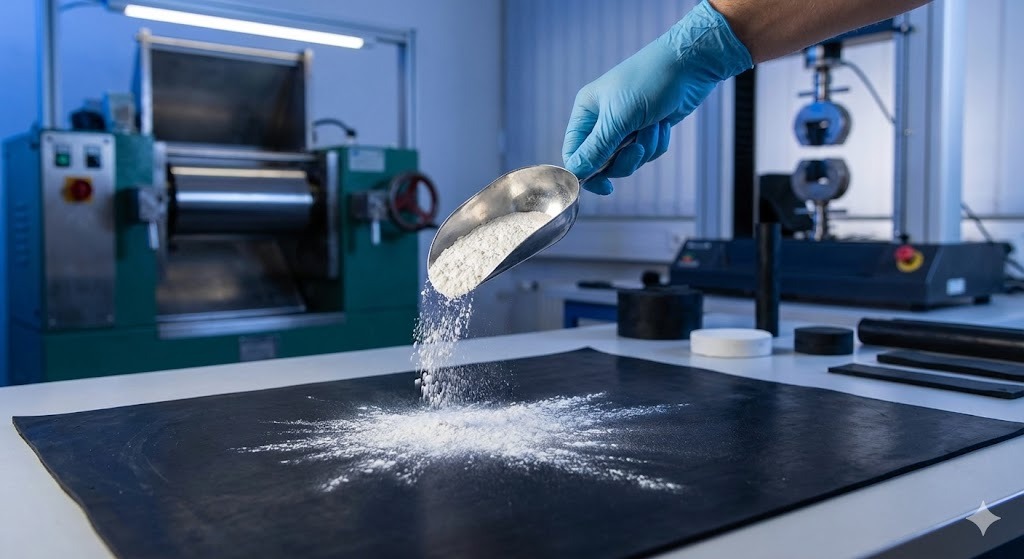
Hello! In the rubber industry, the pressure is always on to improve performance while keeping costs under control. Whether you are compounding EPDM for automotive weatherstripping, manufacturing heavy-duty conveyor belts, or producing precision seals, the ingredients you choose make all the difference. While Carbon Black and Silica are the famous reinforcements, there is another hero in the mix: talc for rubber.
For rubber chemists and process engineers, talc is far more than a simple “filler” used to bulk up volume. It is a functional additive that solves processing headaches and enhances the mechanical properties of the final product.
At Winstone Technology, we are a dedicated manufacturer based in Thailand. We understand the complex chemistry of rubber compounding. We engineer our talc to interact perfectly with your elastomers, ensuring that your production line runs smoother and your products last longer.
What is Talc for Rubber?
Talc is a naturally occurring mineral (hydrated magnesium silicate) with a unique “platy” or lamellar structure. In the context of talc for rubber, these microscopic plates are the key to its functionality.
Unlike spherical fillers (like calcium carbonate) that just take up space, talc’s plates slide over each other. This provides lubrication during processing but creates a rigid “skeleton” once the rubber cures. Furthermore, talc is naturally hydrophobic (it hates water) and lipophilic (it loves oil/rubber), making it chemically compatible with organic elastomers without needing expensive surface treatments.
Why Winstone Technology is Your Ideal Manufacturing Partner
Sourcing raw materials from a general trader often leads to inconsistency. In rubber manufacturing, a slight variance in particle size or pH can mess up your cure rate or viscosity.
Winstone Technology is a direct manufacturer. We operate our own factory in Samuthsakorn, backed by decades of expertise from our parent company (China Trading Co., Ltd.).
- We Control the Grind: We mill our talc to precise particle size distributions (PSD) to ensure it disperses easily into your rubber mix without clumping.
- We Guarantee Purity: Contaminants like iron or copper can age rubber prematurely. We ensure our talc is pure and safe.
- We Are Local: Based in Thailand, the “Rubber Hub of the World,” we are strategically positioned to support local and international manufacturers with fast, stable supply.
3 Critical Functions of Talc in Rubber Compounding
Why should you include Winstone’s talc in your formula? Here are the technical benefits:
1. Processing Aid: Reducing Viscosity and Energy
Mixing rubber is energy-intensive. High-viscosity compounds generate a lot of heat and can damage equipment.
- Internal Lubrication: The platy structure of talc acts as an internal lubricant. It reduces the Mooney viscosity of the compound, allowing it to flow more easily through extruders and into complex molds.
- Faster Extrusion: Lower viscosity means faster extrusion rates and smoother surfaces on profiles (like window seals), boosting your factory’s output.
2. Reinforcement and Dimensional Stability
While not as strong as Carbon Black, talc is a semi-reinforcing filler.
- Modulus Improvement: It significantly increases the stiffness (modulus) of the rubber, which is vital for hoses and gaskets that need to hold their shape under pressure.
- Reduced Die Swell: When rubber exits an extruder, it tends to expand (swell). Talc’s platy structure aligns with the flow, locking the rubber in place and reducing this swell. This ensures your final product meets precise dimensional tolerances.
3. Barrier Properties: Keeping Air In and Water Out
Because talc plates overlap like shingles on a roof, they create a tortuous path for gases and liquids.
- Permeability: In tire inner liners and fuel hoses, talc reduces the permeability of air and fuel.
- Weather Resistance: It improves the rubber’s resistance to water and weathering, extending the service life of outdoor rubber parts like EPDM roofing membranes.
Specific Rubber Applications
Our industrial talc powder is compatible with a wide range of elastomers:
- EPDM (Ethylene Propylene Diene Monomer): This is the largest market for talc. Talc improves the extrusion speed and surface finish of weatherstripping and seals used in cars and construction.
- Automotive Tires: Used in the inner liner to improve air retention and in the sidewall to improve durability.
- Electrical Cables: Talc improves the electrical insulation properties of the rubber coating.
- Latex Gloves: Used as a safe, effective anti-tack agent to prevent gloves from sticking together.
The Anti-Stick “Dusting” Agent
Beyond compounding, talc is universally used as a dusting agent. Uncured rubber is sticky. To prevent sheets of rubber (compounds) from fusing together during storage, manufacturers dust them with talc. Winstone produces specific grades that coat the rubber evenly without generating excessive dust in the factory air.
Sustainability and Cost Efficiency
Rubber ingredients have risen in price. Talc offers a solution.
- Cost Reduction: Talc is generally more cost-effective than polymer resins or specialty blacks. By maximizing the loading of talc (without sacrificing performance), you lower the volume cost of the final part.
- Energy Savings: By acting as a processing aid, talc reduces the energy required for mixing and extrusion, lowering your carbon footprint.
Safety First: Asbestos-Free Assurance
In the rubber industry, worker safety is paramount. Winstone Technology guarantees that our talc for rubber is 100% Asbestos-Free. We meticulously select our ore and test our products to ensure they meet strict safety standards, protecting your workforce and your brand reputation.
Product Specifications for Rubber Grades
We offer specific grades optimized for the rubber industry, balancing particle size for dispersion and structure for reinforcement.
| Product Code | Whiteness (L*) | Particle Size D50, D97 (Micron) | Best Application |
| WIN7D27R (P0151007025H) | 92 min. | 6±2, 20±3 | General Rubber Goods, Anti-Stick Dusting |
| WIN7D27R (P016A1007025H) | 94 min. | 10±2, 37±3 | EPDM Extrusion, Tire Inner Liners |
| WIN7A17R (P0191007025H) | 96 min. | 6±2, 20±3 | Technical Seals, Automotive Hoses |
| WIN7A17R (P0301007030H) | 96 min. | 4±2, 15±3 | Precision Molded Parts |
Frequently Asked Questions (FAQs)
1. Does talc affect the cure rate of rubber?
Generally, talc is chemically inert and does not interfere with the vulcanization (curing) process. However, pH levels can sometimes have an effect. Winstone ensures our talc has a neutral to slightly alkaline pH, which is safe for most cure systems.
2. Can talc replace Carbon Black?
Not entirely. Carbon Black provides superior tensile strength and abrasion resistance (black color). Talc is a “white reinforcing filler.” It is used alongside Carbon Black to improve processing and reduce costs, or used alone in non-black rubber products where Carbon Black cannot be used.
3. How does talc improve EPDM extrusion?
Talc particles align in the direction of the flow. This reduces the friction between the rubber and the extruder metal, allowing for higher speeds and a smoother surface finish on the final profile (no shark-skinning).
4. Is your talc suitable for tire manufacturing?
Yes. We supply grades used in inner liners for air retention and as processing aids for tire sidewalls. We also supply anti-tack grades for process dusting.
5. Do you offer samples for lab testing?
Yes. We know rubber compounding is an exact science. We are happy to provide samples so you can run rheometer tests and verify the physical properties in your own lab.
Contact Winstone Technology
Ready to improve your rubber compounds? Partner with a manufacturer who speaks the language of polymers. Contact Winstone Technology today for technical data sheets and factory-direct pricing.
China Trading (Bangkok) Co., Ltd. / Winstone Technology Co., Ltd.
- Address: 109/4, 109/25, 109/26 Moo 9, Soi Wo Po O. 11 (Suanluang 13), Settakit Road, Tumbon Suanluang, Amper Krathumban, Samuthsakorn 74110, Thailand.
- Mobile: (66) 086 990 1066, (66) 097 037 3585
- Email: small.lampg@gmail.com
- Line ID: 0869901066
- Website: https://winstonetechnology.com/
References
- Rubber Division, ACS (American Chemical Society). (n.d.). Rubber Chemistry & Technology. https://www.rubber.org/
- ScienceDirect. (n.d.). Talc in Rubber Composites. https://www.sciencedirect.com/topics/engineering/rubber-composite
- Rubber World. (n.d.). Compounding and Testing. https://rubberworld.com/