
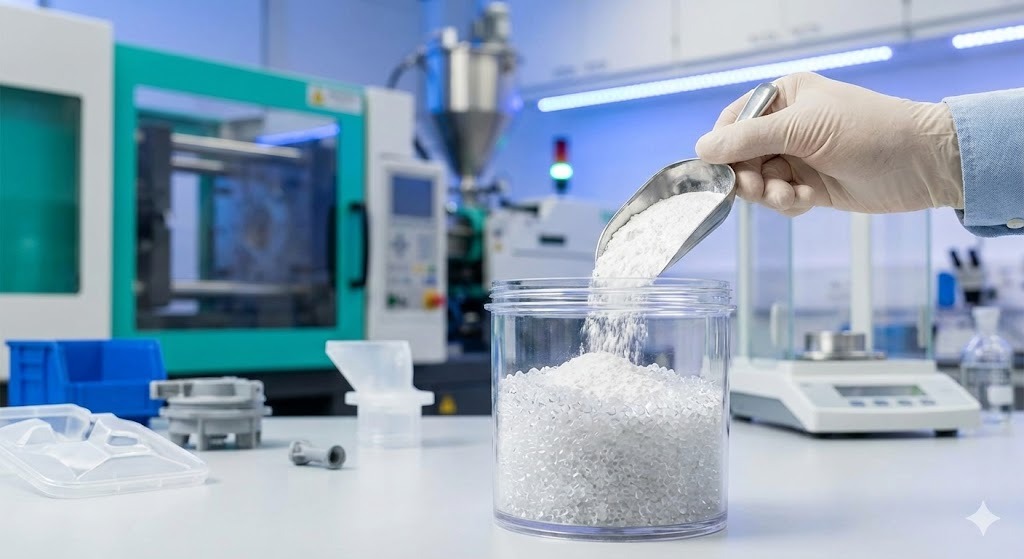
Hello! If you look around you right now, chances are you are seeing something made of plastic. From the dashboard of your car to the casing of your coffee machine or the food container in your kitchen, polymers are everywhere. But here is an industrial secret: pure plastic is often too soft, too flexible, or too sensitive to heat to do the job alone.
So, what gives these plastics their strength and stability? The answer is often talc for plastics.
For engineers and manufacturers, talc is not just a white powder; it is a sophisticated, functional additive. It transforms basic polymers like Polypropylene (PP) and Polyethylene (PE) into high-performance engineering materials. At Winstone Technology, we are a dedicated manufacturer in Thailand helping the plastic industry push the boundaries of what polymers can do.
What is Talc for Plastics?
In the world of polymers, ingredients are generally divided into “fillers” (used to lower cost) and “reinforcements” (used to improve properties). Talc for plastics sits uniquely in both camps, but its true value lies in reinforcement.
Talc is a hydrated magnesium silicate mineral with a platy (layered) structure. When these microscopic plates are mixed into plastic, they align themselves to create a rigid skeleton within the polymer matrix. This structure provides mechanical strength without making the plastic brittle, a balance that few other minerals can achieve.
Why Winstone Technology is Your Ideal Manufacturing Partner
Sourcing talc for plastics requires precision. A variance in particle size can affect the impact strength of a car bumper. That is why buying from a trader is risky.
Winstone Technology is a direct manufacturer. Established in 2014 in Samuthsakorn, Thailand, and backed by the decades-long expertise of our parent company (China Trading Co., Ltd.), we engineer our talc specifically for polymer applications. We control the milling technology to ensure the aspect ratio (the shape of the particles) remains intact, which is critical for reinforcement.
The Science: How Talc Improves Plastic Properties
Adding Winstone’s talc to your polymer mix unlocks three critical physical improvements:
Increasing Stiffness and Rigidity
The primary reason engineers add talc to plastic is to increase stiffness (flexural modulus). The platy particles act like stiffeners within the plastic. For example, adding 20-40% talc to Polypropylene can double or triple its stiffness, allowing it to replace metal or engineering plastics in structural parts.
Enhancing Dimensional Stability
Plastic shrinks as it cools during molding. This shrinkage can cause warping and rejection of parts. Talc reduces this shrinkage significantly. Because talc particles do not shrink, they stabilize the part, ensuring that the molded product matches the mold dimensions perfectly.
Improving Heat Resistance (HDT)
Plastics get soft when they get hot. Talc helps them keep their shape at higher temperatures. By increasing the Heat Deflection Temperature (HDT), talc allows plastic parts to be used in hot environments, such as under a car bonnet or in microwaveable containers.
Talc in Automotive Plastics: Driving Efficiency
The automotive industry is the largest consumer of talc for plastics. Why? Because of the drive for “lightweighting.”
Car manufacturers want to make vehicles lighter to save fuel (or extend battery range in EVs). By using talc-reinforced Polypropylene (PP), they can replace heavy metal parts with lighter plastic ones that are just as rigid. You will find our talc in:
- Bumpers: Balancing stiffness with impact resistance.
- Dashboards and Interiors: Providing a rigid structure that doesn’t warp in the sun.
- Under-the-Hood Components: Resisting the high heat of the engine.
Talc for Packaging: Barrier Properties and Efficiency
In the packaging sector, efficiency is key. Talc allows manufacturers to produce “thin-wall” packaging. Because talc makes the plastic stiffer, you can make the walls of a yogurt cup or a food tray thinner without it collapsing. This uses less plastic overall, saving money and reducing waste.
Furthermore, the platy structure of talc creates a “tortuous path” for gas and moisture. This improves the barrier properties of the packaging, helping to keep food fresher for longer.
Talc in Polypropylene (PP) Compounds
Polypropylene (PP) and talc are a match made in heaven. They are chemically compatible and work together seamlessly. Talc acts as a distinct “nucleating agent” for PP.
The Role of Nucleation
When PP cools down, it crystallizes. Talc particles act as seeds (nuclei) that encourage crystals to grow faster and more uniformly. This reduces the cycle time in injection molding (saving production time) and results in a stiffer final part.
Talc for Masterbatch Production
Masterbatch producers need carriers that can accept high loadings of minerals without clogging their extruders. Our industrial talc powder is processed to have excellent flow properties and low moisture content. This ensures it disperses easily into the masterbatch carrier resin, providing a smooth, high-quality concentrate for downstream users.
The Importance of Particle Size in Plastics
Not all talc is the same size. The “grind” matters immensely in plastics engineering.
Impact Resistance vs. Stiffness Balance
There is a trade-off. Generally, finer talc particles (micronized talc) provide better impact strength (the part won’t shatter when hit) while maintaining stiffness. Coarser talc provides good stiffness but can make the part brittle. We help our clients find the perfect “Top Cut” (D97) to balance these needs.
Surface Finish and Aesthetics
For visible parts, like the exterior trim of a car or a glossy appliance housing, large particles can ruin the finish. We produce ultra-fine talc grades that allow for Class A surface finishes, ensuring the plastic looks smooth and premium.
Sustainability: Talc as an Eco-Friendly Additive
Using natural minerals like talc is a sustainable choice. Talc is a naturally occurring, low-carbon-footprint material compared to synthetic resins. By replacing a portion of the oil-based polymer with natural talc, manufacturers reduce the overall carbon footprint of their finished product. Additionally, talc-reinforced plastics are fully recyclable, supporting the circular economy.
Winstone’s Manufacturing Standards
We take quality seriously. Our factory in Samuthsakorn operates with strict quality controls.
- Purity: We select ores that are free from chemical contaminants that could degrade the plastic polymer.
- Moisture Control: Plastics hate moisture (it causes bubbles). We ensure our talc is dry and free-flowing.
- Consistency: We test every batch for particle size distribution to ensure your molding machine settings never have to change.
Product Specifications Table
Here are the specific grades we recommend for plastic applications, ranging from general compounding to high-performance engineering plastics.
| Product Code | Whiteness (L*) | Particle Size D50, D97 (Micron) | Best Application |
| WIN7D27R (P0151007025H) | 92 min. | 6±2, 20±3 | General Compounding, Pipes |
| WIN7A17R (P0191007025H) | 96 min. | 6±2, 20±3 | Engineering Plastics, Automotive Parts |
| WIN7A17R (P0301007030H) | 96 min. | 4±2, 15±3 | Masterbatch, Thin-Wall Packaging |
| WIN7A17R (P0321007030H) | 96 min. | 4±2, 9±3 | Precision Parts, High Impact PP |
| WIN7A17R (P0331007030H) | 96 min. | 3±2, 7±3 | Fine Films, High Gloss Surfaces |
Frequently Asked Questions (FAQs)
1. Does adding talc make plastic brittle?
If you use the wrong size or too much, yes. However, using the correct grade of fine talc actually maintains a good balance. It increases stiffness significantly while maintaining acceptable impact resistance. Our technical team can help you choose the right grade to avoid brittleness.
2. Can talc be used in bioplastics?
Yes. Talc is an excellent additive for bioplastics (like PLA) to improve their heat resistance and processability, which are often weak points for bio-based materials.
3. How does talc affect the weight of plastic parts?
Talc is denser than plastic resin, so it increases the specific gravity (density) of the compound. However, because it makes the plastic so much stiffer, you can design parts with thinner walls. This “thin-walling” usually results in a net weight reduction for the final part.
4. Is your talc abrasive to molding machinery?
Talc is the softest mineral on earth (Mohs 1). Unlike calcium carbonate or glass fiber, talc is non-abrasive. It causes very little wear and tear on your extruders and injection molding screws, extending the life of your equipment.
5. Do you offer samples for trial runs?
Yes. We understand that plastic compounding requires testing. We are happy to provide samples of our various grades so you can run trials in your extruder and verify the mechanical properties.
Contact Winstone Technology
Ready to engineer stronger, better plastics? Partner with a manufacturer who understands polymers. Contact Winstone Technology today for technical data sheets and factory-direct pricing.
China Trading (Bangkok) Co., Ltd. / Winstone Technology Co., Ltd.
- Address: 109/4, 109/25, 109/26 Moo 9, Soi Wo Po O. 11 (Suanluang 13), Settakit Road, Tumbon Suanluang, Amper Krathumban, Samuthsakorn 74110, Thailand.
- Mobile: (66) 086 990 1066, (66) 097 037 3585
- Email: small.lampg@gmail.com
- Line ID: 0869901066
- Website: https://winstonetechnology.com/
References
- Society of Plastics Engineers (SPE). (n.d.). Plastics Engineering Resources. https://www.4spe.org/
- Omnexus (SpecialChem). (n.d.). Talc: The functional filler for plastics. https://omnexus.specialchem.com/selection-guide/talc-plastic-filler
- Plastic Technology Online. (n.d.). Additives & Fillers. https://www.ptonline.com/zones/additives-fillers